
Showing posts with label Writing. Show all posts
Showing posts with label Writing. Show all posts
A Translation from ‘The Chronicles of the Fingers of Your Left Hand’

The Mighty Zorok: Office Monster
The Mighty Zorok: Office Monster is now available as an exclusive Kindle short at Amazon.com. Buy your copy today, and check back here for bonus content in the coming weeks.

Midge and Bimboo

There's a children's story developing here. Stay tuned . . .
Here's Page 1:

This is Midge.
Here's a new cover image and page 2:


This is Bimboo.

Bimboo wants to eat Midge.
Page 4:

Midge should run.
Page 5:

Midge runs.
New Page 5:

Midge runs.
New New Page 5:

Midge runs.
Page 6:

Bimboo runs.
Page 7:

Bimboo chases Midge.
Page 8:

Midge comes to a cliff.
Page 9:

Midge can't run anymore.
Page 10:
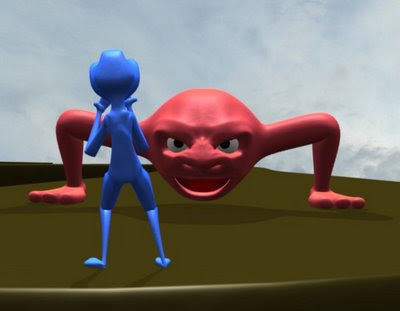
Bimboo opens his mouth.
Page 11:

Midge has an idea.
Page 12:

Bimboo charges.
Page 13:

Midge jumps.
Page 14:

Bimboo falls.
Page 15:

Midge is safe.
Page 16:

For now . . .
Alternate textures:


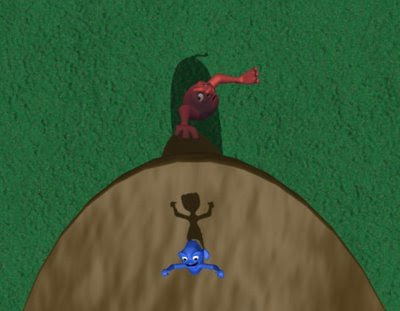

Here's a new cover image and page 2:


This is Bimboo.

Bimboo wants to eat Midge.
Page 4:

Midge should run.
Page 5:

Midge runs.
New Page 5:

Midge runs.
New New Page 5:

Midge runs.
Page 6:

Bimboo runs.
Page 7:

Bimboo chases Midge.
Page 8:

Midge comes to a cliff.
Page 9:

Midge can't run anymore.
Page 10:

Bimboo opens his mouth.
Page 11:

Midge has an idea.
Page 12:

Bimboo charges.
Page 13:

Midge jumps.
Page 14:

Bimboo falls.
Page 15:

Midge is safe.
Page 16:

For now . . .
Alternate textures:



New Story in FRiGG -- When My Girlfriend Lost the Weight
My latest short story, "When My Girlfriend Lost the Weight" is now available at FRiGG Magazine. You can read it by clicking here.
It's about a girl who stops eating and goes from 143 to 0 pounds.
It's about a girl who stops eating and goes from 143 to 0 pounds.
She Falls Down -- Short Story
Originally published in Opium Magazine
She Falls Down
She falls down. Whenever I kiss her. Whenever I ask her where she's been. Whenever she sees Mr. Miyagi nod at Ralph Macchio in the last scene of The Karate Kid.
It's a congenital neurological disorder. Something about the frontal lobe. Something about endorphins and oxygen, extreme emotions cutting off blood flow. I can never pay attention to the doctors long enough to understand it. Apparently, it's common in a certain kind of goat.
But what does it matter? It is what it is. It's not going to change how I feel. It's not going to change how I act.
"I'll be damned if I'm going to walk on egg shells around you," I tell her.
She collapses. Of course.
The bruises scatter across the back of her head, her neck, her thighs, her shoulder blades. They become constellations of our emotional life one week at a time. Each purple blotch is a memory. This is the argument over the fact that my mother still buys my underwear. This is the gentle kiss I placed on her throat last week. This is the time I told her I dreamt we were old and married with six children, one five years old, slightly retarded, and unable to pronounce "Mom," so instead she called her "Mush."
I've tried placing pillows around the house. We've coated the coffee table in bubble wrap. It only helps a little. The world has more edges than you can soften. We never realize how much things hurt until she falls on them.
And I've tried catching her. Admittedly, I used to put more effort into it, but it doesn't matter. What am I going to do? Make sure I'm standing behind her every time I open my mouth, every time the Bee Gees come over the radio, every time the newspaper runs a story about some kid with no legs who's competing in the state high school pole vault finals. At best I could get to her half the time, and even then I can barely break her fall. It's not like in the movies. When women fall, they fall hard. Dead weight--even 120 pounds of it--is heavy enough to knock you on your ass.
I tried to leave her once. This was before we moved in together. Back when we'd been dating for a month or two. We'd gone out for tappas at some new Mediterranean place. I'd had three glasses of plum wine and told her I thought I was falling in love. She shattered her wine glass with her face, then slumped sideways out her chair and hit the ground nose first. Blood everywhere.
"It's for the best," I told her in the emergency room lobby.
She wobbled slightly, put a hand on one of the plastic chairs. "This is me," she said. "With you, without you. You can't change that."
"But I'm obviously not healthy for you," I said, clumsily gesturing toward the gauze covering half her face.
"It's not about me. I'm fine with this. I've lived with it my whole life, and I can handle it. Maybe you can't. Maybe I'm not healthy for you, but don't act like you're doing me any favors."
There you had it. It was like a challenge. Stick around or admit I was a wuss. Plus, plum wine or not, I was falling in love with her.
In time, I actually grew used to her condition. It was exciting in a way. We lived always on the edge. Each moment held the promise of disaster. She fell down the steps. She knocked over breakables. She crashed into the shower curtain, tearing it loose from the rod ring by ring as her wet naked back clung to it. She fell over while driving, slumped against my shoulder as I frantically grasped the wheel and steered us into the curb.
By the time we moved in together I'd grown fascinated with the things that might knock her over. I kept a record of her collapses. Monday: Found out sister was pregnant -- fell into living room entertainment center. Tuesday: talked to mother on phone -- tumbled head-first into kitchen sink. Wednesday: found old high school year book -- slumped gently to bedroom floor.
The more time we spent together, the more fascinated I grew with the whole thing. Sometimes I would just sit and watch her, waiting for the moment her body would slip from her control. You could see it almost before it happened. Her muscles would suddenly relax, an eerie calm washing across her flesh. Then everything would go slack. I'd watch her shoulders slump and knees buckle, everything so fluid, so free. All of it giving in only to gravity, limbs splayed across the floor like something spilled.
I have over 100 photographs of her collapsed on the carpet, draped over a sofa, stretched out on a staircase. No two poses are the same.
So we're together for a year, and things are good. But then about a month ago, she starts disappearing for long stretches. Showing up after nights away with bruises I'd never seen before. She asks me to touch them, press my fingers into their center so she can feel the pain fresh.
Obviously, confronting her gets me nowhere. So I hack into her e-mail. I get her password "gravitylove1" in three guesses and find all these cryptic messages from some guy she works with. Chris. It's all inside jokes and innuendo, so who knows? But then I call around, ask her other coworkers.
"Has she been falling down a lot at the office lately?" I ask.
They tell me yeah, and I know I'm screwed.
Week by week I see her less and less. She goes days without falling in front of me.
Of course, I torture myself wondering what he has that I don't. Plush furniture? Padded floors? Does she want the falls to be better or worse? Should I buy some marble end tables? Rig up a system of ropes and pulleys so she can move about the house without ever touching the floor?
It's no use. If I bring it up she gets moody and distant. "You don't get it," she says. "There's more to me than this. The majority of the time, I'm on my feet. You'd think you could show some interest in that."
A week ago we get into a screaming match over a long bruise on her calf I'd never seen before. I call her a whore, a slut. I break down in ridiculous tears, fall to the floor. She doesn't even look dizzy.
Then, last night without coming home, she calls to tell me she's leaving. She'll be coming by today to pack up her stuff. I begged her not to bring him with her. Then I went to sleep and had this dream.
It's all I can think of now. Like a revelation, an omen, something.
I dreamt I built her a house without floors. A world without floors. It was one of those dreams that seems like it goes on for weeks. She fell endlessly, her limbs limp, contorting in slow circles as she tumbled against nothing. I woke up with my hair wet at the temples from my tears, my face sore from smiling.
When she gets here I will tell her about the dream. How her back arched and her legs swam wildly, how she turned clumsy somersaults over and over, how her hair spun out from her head, tangling around her fingers as they grasped at the air. I will make her see herself through my eyes—endless, free.
I can only hope that there's enough still there to knock her on her ass. That she will fall and I will tell her the dream over and over. That I will tell her the dream, and she will never leave.
Gelda The Goblin Girl -- Pic
Here's the first sample from "Gelda the Goblin Girl: A Fairy-Tale for Future Activists," a new children's book I'm working on at the moment.


Buy My Book
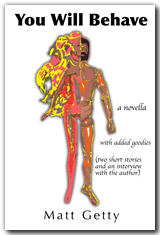
You Will Behave begins with a mother reprimanding her son for raping his sister's Barbie Doll with Darth Vader's light-saber. She tells him that he will apologize, that he will bury the doll, that Darth will look Ken in the eye and confess his crime.
Only she doesn't stop there.
In this same tone, she proceeds to tell her son his entire life story. The result is a dark and uproarious tale of love, violence, and what little difference there is between the two. Told entirely in the second person future, You Will Behave is at once a heart-felt coming of age story and a send up of the very idea of coming of age at all.
Buy it at Amazon.
Or just learn more.
Or just post your review.
Oncoming Traffic
Originally published in the Fall 2005 issue of Streetlight Magazine.
Nominated for a 2005 Pushcart Prize.
Oncoming Traffic
A deer leaps through the woods. Branches and dry leaves crack away from its body. Just beyond the trees ahead lies a familiar road it understands only as a hard place two strides long. It is unafraid and unaware of the possibility of oncoming traffic.
Lisa Tomlinson sits in her silver Toyota two-door driving north on Old Blaine Road considering the pros and cons of dumping her boyfriend, Zeke Thomas—a quiet, sturdy, buzz-cut young man sitting in the passenger seat beside her. She is looking at the vein running the length of his forearm when she sees from the corner of her eye a patch of beige fur burst through the foliage twenty feet from the left side of the road.
The sight means nothing to her at first. At a rate of forty miles per hour, which translates loosely to fifty feet per second, Lisa travels thirty-five feet before she even realizes that this bouncing patch of fur emerging from the trees is indeed one of the very deer threatened by the traffic sign two miles back. She is, in fact, cocking her head to the left, sucking air meditatively through her teeth, and wondering what it is about a vein that could be so simultaneously attractive and repulsive, when—bam: sight pulls together with thought, and suddenly, out of the corner of her eye, a deer happens.
“Oh my God,” she says.
Tom Manson, tense behind the wheel of an overstuffed mini-van, driving southbound on Old Blaine Road at a fifty-mile-per-hour clip, twenty minutes into the family camping trip he’s been planning for seven months, does not see the deer. He has seen the traffic signs on his side of the road, but right now he’s got other things on his mind. To his right, there’s Jane, the wife steadily receding further and further behind a veil of plastic surgery and sexual apathy; in the child safety seat on his rear flank, there’s Dylan, the three-year-old son who grinds his teeth and cries in his sleep; and, directly behind, there’s Mike, the fourteen-year-old son who shows no interest in life beyond the narrow slice offered within the pages of a tattered book of old-time baseball statistics he insists on carrying with him wherever he goes.
With his eyes tunneled on the road directly in front of the hood, Tom thinks back to the day Mike was born. He’d wedged his arm between his wife’s neck and the hospital pillow, held her in her bed as she held their tiny red-faced baby, and felt sure that he never wanted to move. He wanted to be a family—never pull away, never get up from that bed. There was a phrase he’d thought for a long time, playing it over and over in his head since he was eighteen as if it were a line he was memorizing for a play he’d be performing someday for the rest of his life, and suddenly he felt the opportunity to say it. “You know,” he said, turning his face toward his wife’s, “I finally know what I want to do when I grow up. I want to raise children.”
Now, this memory embarrasses him. He cringes as if he were remembering the day he declared that his goal in life was to change the face of rock music, and he thinks of a recurring dream in which he sees his youngest son, Dylan, twenty years in the future. They are seated at a square table with a deep burgundy tablecloth. Dylan, perched atop a barstool, looks down on him, as he seems to be squatting on a footstool or sometimes on an end-table or cinder block. At some point there is a toast, the two men touch glasses, and Tom, in a tender yet deep and confident voice, says, “You know son, it took me almost twenty-five years to realize it, but when I saw your brother born, I decided that what I wanted to do with my life was raise children.” Dylan sighs through a sneer, then chuckles. “Really?” he says, and Tom is about to nod solemnly when his son cuts him off. “What children?” he demands. “Really, what children were you talking about? Hell, I’d love to meet them, cause you ain’t done shit for me or Mike.”
#
“What?” Zeke asks.
He wonders at the cause of Lisa’s dramatic “ohmygod,” hoping this is not another instance of the enigmatic, unreachable moodiness she has adopted recently, when he sees the deer, sees the mini-van streaking toward its path, but fails for a moment to fully understand what is about to happen.
The deer plunges forward carrying its small rack of antlers with such grace that Zeke is at first sure that he is looking at a picture of a deer rather than a live animal. He dismisses this thought in an instant, but its residue combines with his momentary worry over the “ohmygod” to invoke an unwanted memory from an anthropology course he took with Lisa a little less than a year ago.
The topic of discussion was art in prehistoric tribal cultures—cave paintings to be specific. The professor, using a deer as his example, had asked the class to theorize the reason why primitive tribes felt compelled to render the animal form on the wall of a cave. Several students, including Zeke, offered utilitarian explanations—hunting diagrams, pictorial instructions—but then Lisa wearily leaned back in her chair, threw up her hand, and calmly dismissed the entire notion of utility.
“It’s not for any useful reasons,” she said. “Think about it. These people didn’t have much time on their hands. There’d have to be a quicker way to teach hunting than painting a deer on the wall. I say, if they took the time to paint a deer on the wall, it was basically because they had to paint it—just like they had to kill it. They had to have it. They saw the deer and they just couldn’t resist some primal urge to hold it, to stop it, to keep it still.”
Zeke looked over at the chair-desk next to his and was struck by how remote his girlfriend had just become. With her eyes focused on the professor and her mouth moving intently and precisely, Lisa suddenly looked to him as if she had been placed on the small end of a telescope. He listened as she defended her explanation against questions from a few students, watched her drift further and further away from that quasi-emotional space he designated as his own, and understood for the first time why, when he embraced this girl, he felt the need to hold her so tightly that her back sometimes complained in rapid-fire crackles—or why, when he gripped her fingers, he always felt as if the constant motion of living had momentarily stopped.
As the deer nears the road and the mini-van barrels steadily forward, the memory strikes Zeke as an idea, and he wishes, with the desperate intensity of all impossible wishes, that the deer would simply freeze.
The deer, of course, does not freeze. It charges across the grass with only the whip of the taller weeds, the streaming smell of the dead autumn air, and the rhythm of its hooves to guide it. There is nothing now but run.
“Keep still!” Jane Manson snaps as she turns forward, away from her youngest son, and settles back into her seat. Dylan whines angry gibberish in that high-pitched car-alarm tone Jane wishes she could permanently disable. She allows herself a theatrical sigh as she glances sidelong at her husband wondering how he can tolerate his children simply by ignoring them. She remembers him ten years ago stretched out on the sofa as she walked in the door, her arms bulging with grocery bags, to find Mike huddled in the corner of the living room busily dismantling the antique clock she’d spent months restoring.
She watches Tom out of the corner of her eye, and his face refuses to show the slightest sign of annoyance or anger as he stares straight ahead at the road. His strong chin, deep-set eyes, and long Roman nose look to her almost exactly the same as they did on the day she met him eighteen years ago, and she can’t help but realize that the true horror of marriage is not that people change, but rather that they do not. Wondering then at her own efforts to keep time still with scalpel and Botox, as if she were trying to match her husband’s steadfastness non-stride for non-stride, she tilts her head to the right and glances at her shrunken reflection in the side-view mirror.
That’s when she sees the deer—or not really the deer so much as a blur of beige impact. Solid motion into solid motion shoots her up in her seat, veers the car wildly to the left, and releases a gasp from the tightness of her throat.
Suddenly the running is no more. Forward is replaced by a sudden attack, a painful lurch, a weightless lifting. The deer bounces off the right front corner of the mini-van. It flies awkwardly back toward the shoulder of the road, its limbs and head trailing its body as it bends toward the ground like an empty bag tossed by the wind.
#
Lisa sees it happen. The collision echoes inside her stomach as she watches the deer fly back toward the roadside and the mini-van skid into her lane. She clenches one hand on the steering wheel and reaches the other toward Zeke’s chest. For a moment, as the mini-van hurtles toward her, less than twenty feet away, she thinks of nothing. Her entire body shudders into action, and she stands down on the brake, throws the wheel to her left, and swerves into the open lane, dodging the mini-van by less than three feet. As the deer shudders and then settles into the gravel to her left, Lisa cannot help but turn and follow it with her eyes. She watches the animal raise its head and then slump back to the pavement just a few feet from her car. It takes less than a second, but as Lisa speeds by and swivels her head, she is sure that she and the deer make eye contact. As she turns back toward the road, lifts her foot from the brake and continues to drive straight ahead on the left-hand side, thought returns in a rush and she feels like she understands something. Already she is recalling the twisted half-open mouth, the wide brown eyes, the face that held something painfully human in its confused despair. Already she is replaying the motion of the neck resting after the body, the head falling to the pavement like a child’s sinking into the pillow after a long day.
She will try to tell this story many times. Friends will hear repeatedly about how she felt those eyes looking into hers, how she thought she could almost hear the animal sigh out an exhausted breath. But they will be more interested in the details of the accident—the make of the other car, the speed upon impact, the size of the deer. They will depart unsatisfied.
Now, she is just driving forward. With one hand still pressed against Zeke’s chest and the other wrapped around the wheel, she shows no signs of stopping. Then someone’s fingers wrap around her right arm and she feels each of them pressing small, slippery electrical currents into her flesh.
“Slow down,” Zeke says. “Slow down!”
She lifts her foot slowly off the gas, but the rest of her body stays tense. Breaths come quickly and loudly, and her entire body feels as if it is ready to shudder, but cannot.
“Lisa!” Zeke shouts. “Stop the car. We’ve got to go back and see if they’re OK.”
She does as he says. Why not? Everything suddenly feels so good. Her palm pressed against his chest, his fingers curled around her arm, her breath gasping in and out, rolling back and forth over her lips . . . By the time the car slows to a stop, even the air caresses her skin.
This is when she does what she doesn’t expect. Relaxing her right arm, Lisa turns to Zeke with a panting smile, then leans toward him and kisses him passionately. His mouth tenses at first, but he does not resist. Though his arms never claim her, his lips part, and soon they are both kissing each other desperately and recklessly, with no thought of where they are or what has just occurred. Lisa does not know it now, nor does she care, but this kiss will be the greatest kiss of her life. Zeke will pull away in a minute, spill out of the car and trot up the road, and she will leave him in less than a month . . . But decades from now she will tell her grandchildren about this wonderful boy she could not love, and almost killed, but then kissed in a way she never quite kissed anyone before or ever again.
Dylan wriggles back and forth in his car-seat, desperate to see anything. He knows that something has happened but he does not know what. First came the crunch, then everything was tugging to the side and grinding to a stop. Something was already flying away, and then a young man with army hair went rolling past his window. But now the van is stopped and everyone is just breathing and touching one another. His mother’s hands crawl over his stomach tightening the straps of his seat.
“Stay put,” she says between the clicking of her long red nails against the belt, but Dylan is not looking at her. His eyes are locked on the back of his father’s head and the small gray patch of stubbly cheek that faces him.
Dylan never knows what to expect from his father. His mother he has down. He knows the noises he needs to make to get her to smile, laugh, or grit her teeth and ball up her fists. But his father, always driving, talking to the television, or blinking into a computer screen, remains a mystery. Dylan often looks toward him with the same cautious tilt of the head he uses now, watching this quiet hairy man called Dad superstitiously and ominously, much in the same way sailors once watched the sky.
Doors pop open, and Dylan stops wriggling as his father steps out of the car. He looks over at his brother, glances up at his mother, and then, as his neck and body relax, he realizes without shame that he feels most comfortable when his father is gone.
Mike Manson is old enough to feel a vague sense of regret about the fact that he is most comfortable when his father is gone. Thus, as he sits cradling a nine-hundred page Bill James Historical Baseball Abstract, he wonders if he should follow him. The speed of recent events is just now beginning to slow down in his mind, and he knows only in some strange mixture of recollection and realization that his father has just hit a deer.
“Boys,” his mother says as she twists back toward him with her sleek expressionless face, “you just stay put.” With that, she pushes her unlatched door the rest of the way open and exits the vehicle.
Mike glances at his brother and frowns at his worried stare. Dylan’s forehead bunches into wrinkles and his upper lip curls toward his nose in the way it often does when Mike refuses to let him follow him up to the baseball field behind their house. Softly, Mike whispers the words, “cry, baby,” and then turns away.
Mike feels certain that when he grows up he will not have children. In fact, he is sure that as soon as he grows old enough to leave this family, he will do whatever it takes to extricate himself from the mess of family life altogether. The last twenty minutes—with their tangled line of tantrums, fast-food, and one dead deer—rush into his mind as an insult to the stable and solid facts of Ted Williams’ 1941 .406 batting average, or Joe DiMaggio’s fifty-six game hitting streak of the same year. In short, they are a weak challenge, a limp-wristed slap in the face of the American ideal of perfection, which he, at fourteen years of age, knows to be nothing less than attainable.
Through Dylan’s window Mike can see the sprawled body of the deer twenty feet back on the side of the road. As Dylan turns away from the sight, his face begins to tremble and tears roll down his cheeks. Mike looks at him and feels gripped by a spasm of hatred. “Baby,” he spits toward his brother, and then turns away, clutches his almanac with one hand, and unlatches his door with the other. Before Mike’s foot even hits the pavement, Dylan is wailing with the shrill, piercing intensity of a siren.
A tall middle-aged man in khaki pants and a dark argyle sweater, and a thin blonde-haired woman wearing tight jeans and a billowy white blouse are already standing over the deer by the time Zeke has trotted to the side of the road.
“You all OK?” he calls out.
The man turns, shading his eyes with his hands and says, “Think so. How about you?”
Zeke nods and the moment stretches into an awkward silence. “I guess it could have been a lot worse,” he offers, not sure what to say. “We almost had a real head-on collision there for a second.” Immediately, Zeke hears his last sentence as an accusation and wants to take it back. That being impossible, he hurries forward, as if saying something else will cover up what he has just said. “Got much damage to your car?”
At this, the man in the khaki pants turns once toward the deer, spins awkwardly to look back at his mini-van, and then flashes a weak smile back at Zeke. “Don’t know,” he says glancing all around again. “I’m really not sure yet.”
Up the road, Zeke sees a thin long-legged boy circle around the back of the mini-van and head in his direction. “You got kids in there?” he asks. “The kids OK?”
Once again, the man looks at the deer and then turns back to Zeke. “Don’t know,” he says. “I really don’t even know what just happened.”
The smile, the shrug, and the simple soft-voiced “don’t know” strike Zeke as more than odd. They seem almost guilty, as if this man he doesn’t know is confessing something to him. Zeke looks at the mini-van, the woman who must be the man’s wife, the child who must be the man’s son, and feels something between envy and disappointment. These, after all, are the promises of the secure life Zeke has always planned. Man and wife. Father and child. Family. But here, in the presence of a prostrate deer, in the wake of a near accident of time and traffic, this strange man, complete and strong enough to hold his entire family in his car, simply shrugs and smiles, as helpless as a child who has just overturned a glass of milk.
Tom squats down slowly beside the deer. Its tangled, clumsy-looking legs and twisted neck immediately strike a chord, as does the subtle rise and fall of the white fur at the bottom of its throat.
“It’s still breathing,” the young man says from behind him. “It’s not dead.”
“Yep,” Tom answers.
“Well, what do we do?” Jane asks in a hurried voice as she shuffles out onto the pavement.
“What do we do?” She holds her hands out toward Tom. Her long red fingernails catch slivers of sunlight, but he ignores her. With his eyes focused on the rising and falling patch of fur, the wet rolled-back eyes, and the half-open mouth, Tom is suddenly twelve years old, crouched in the woods behind his parent’s house, cringing tensely as his father stands behind him shouting, “Kill it! Kill it!”
They’d waited in the deer stand until the dew had soaked through both layers of the thermal-wear socks Tom had pulled on that morning. Three times he had let his eyes drift closed, and three times his father had stabbed his ribs playfully with his elbow, telling him to “Keep eye, keep eye.” Then, just at the point when the stillness, the waiting, the chirping silence, and the blank morning gray of the horizon seemed ready to crush him, Tom saw a scrap of deer flash through the tangle of trees and bushes about a dozen feet to his left. Impatience spilled out of his body in a rush, and in a single motion he aimed and fired his rifle. A patch of blood sprayed out from the nearest foreleg, and in an instant, the scrap of deer was gone.
Before Tom could even think to stand up, he was scrambling into the trees with his father, following the trail of blood from branch to branch and leaf to leaf, murmuring, “I don’t know,” to his father’s questions about the deer’s size and point-count, and panting in shallow, excited breaths. Then he stepped between two oak saplings and entered a muddy clearing where there lay a small, crumpled fawn gasping weakly and bleeding steadily from a small hole in its fore-shoulder.
“Oh, Jesus,” his father cried out just behind him. “You hit a fawn. Shit. It’s just a pup, kid.”
Tom was already on his knees, planted into the cold mud two feet from the struggling body. He didn’t want to be out hunting deer anymore. He knew what he had to do. It was a mistake to begin with, but he had to finish it properly—put the animal out of its misery. Only then, as he looked at it, he didn’t see misery. He saw a small twitching animal struggling desperately to live, still pumping its legs in a weak attempt to run away from everything. His father was already shouting behind him, telling him he had to shoot the fawn, telling him that it was right, it was good, it was merciful, but Tom could not move. Even after his father raised his rifle and fired a roaring shot into the side of the animal’s head, Tom remained there, kneeling in the mud silent and still.
Tom Manson has quietly hated his father on and off for the last twenty-seven years of his life, but now, as he looks down on the face of the deer he has just battered with his family vehicle and his eyes swell with ridiculous tears, he wishes desperately that the old man and his rifle were here by his side.
First, she thought it was a desire to have sex. But then, as she followed Zeke up toward the couple and the deer, Lisa realized it was just an overwhelming need to touch everything. Now she looks at the man squatting in front of the deer and has to grit her teeth to resist the urge to brush her hand along the short hairs on the back of his neck. She feels the world alive and vaguely electric all around her, and it is only her knowledge of tact that keeps her from walking over to Zeke and massaging the smooth muscles of his forearm, or walking over to this woman and rubbing the thin folds of her blouse between her fingers. Still, she is only aware of this knowledge as an artificial corruption, a vague emotional nausea, which seems to fade only at the arrival of the child.
On the other side of the deer, a gangly boy carrying a large book strolls to a stop and looks up at the older faces that surround the body. “Is it dead?” he blurts out, and Lisa, thrilled at the innocent bluntness of his question looks back into his eyes and smiles blissfully.
Her husband has not answered her question, so Jane asks it again. “What do we do?”
“I don’t know,” comes the voice of the young man from the other car, sounding weak but reassuring, like a trembling hand reached out to steady her.
Jane turns to look at the calm, square-shouldered young man and feels for a moment as if she were looking at a composite sketch of all the men she might have married instead of Tom. The neatly trimmed flat-top could have belonged to Rudy, the lisping merchant marine who pinched her arm until it bruised because she would not keep her hand on his lap as he drove her home. The warm brown eyes might have been taken from Max, the teaching assistant who wrote her surreal, imagistic love poems in college. Here, the resemblance is so strong, in fact, that as those eyes fall shyly away from hers, Jane can hear Max reading the cryptic line, “Our love is the pale fish of the evening, sliced open to bleed this dandelion kiss.” Then there’s the mouth—a small, thick-lipped, puckered frown that is entirely Stanley. She sees him clearly on that last night, the night of her ultimatum, the night he refused to propose.
She’d come to his office, where they were supposed to meet before going to dinner in the city, but as usual, he was too busy to take off, and they rehashed a familiar argument in the stairwell outside his office door. She’d told him that if she was going to have to deal with routine disappointment, she at least wanted to have the type of commitment that normally accompanied it. Eventually, he asked if this were an “ultimatum,” and when she said “yes,” he just stared at her with his lips puckered into that compact frown. It was a challenge, a defiance, a maneuver. She knew it was her job to give in, fall against his chest, forgive him, and wait patiently five more months until he got his promotion. But she was tired of waiting. She wanted to get things moving. She could see the next twenty years of her life laid out in front of her in a simple, tunnel-vision future, and she was ready to let one step lead into the next. So she looked at Stanley’s face just until the moment she felt tears burn at the back her eyes, and then she turned and darted down the steps. Stanley called after her twice, but he did not move. “Stop this,” he yelled. But she would not stop. She ran down three flights of stairs, walked four blocks to the subway that would carry her home, and two months later she met Tom at a sad little Christmas party thrown by her second cousin.
Now, looking at the scene before her, Jane is not unaware of its metaphoric possibilities. She sees herself first as this deer running blindly ahead, and Tom becomes the mini-van. But she is flexible. Maybe she is the mini-van, Stanley is the deer, and Tom is this confused young man who can’t even look at her. Then she hears the scraping.
From the ground before her comes the sound of hooves scraping against pavement, and as Jane looks down toward the deer, she realizes that she is wrong, for if she is anything, she is the deer, as she is herself, as she is the mini-van, as she is anyone in this circle of people gathered around this dying animal.
The deer strains to swallow air . With a slow roll of its available eye, it scans the five pairs of eyes that surround it and knows with animal certainty that they are all one thing. The ground, coarse and cruelly shallow, feels strange beneath it, and all around the scents of grass, trees, and mud mingle with the dead smells of metal and stone. Awareness comes slowly, but the deer knows these smells, and fear is much quicker than knowledge. The eye darts rapidly, and suddenly the deer knows that it is being swallowed by this animal that watches it from all sides—this circle that surrounds no matter where it runs. Then, as it feels its legs twitch at the empty air and scrape against the shallow ground, the deer understands that it is not running—that it cannot run unless it stands.
The head is heavy, but with a slow graceful arching, the deer rolls up its neck and then begins to flop violently against the pavement in a frantic attempt to rise.
Mike Manson has seen smiles on women before—his mother’s painful smirk, his teacher’s merciful grin, or even the teasing giggles he sometimes gets from his brother’s baby-sitters—but this is something different. As he looks up into the smiling face of the woman from the other car, something about the simplicity of her expression, the sweaty glow on her forehead, and the wild gleam in her eyes combine to inform him that she is the most beautiful thing he has ever seen. The curve of her thigh and the exact contour created by the way her jeans hold her settle for him once and for all the question of why his friends spend the majority of the junior high dances clutching at their classmates while he leans up against the bleachers recreating over and over in his mind the perfect balanced swoop of Sammy Sosa’s swing. Thus, as he relaxes his hand in mute appreciation of an imagined dance with the perfection of this woman he does not know and the Bill James Baseball Abstract slips from his grip, splashes to the pavement, and startles him back to reality, Mike is the last of the circle to see that the wounded deer is standing.
Each in the circle takes a step backwards, spreading arms in unison, and from where Dylan sits inside the mini-van, it looks almost as if they are holding hands, forming a ring around the crippled deer as it staggers up on its haunches. Dylan leans into the window, gasps back his tears, and stops screaming. Now he is only watching. He cannot understand what he sees, but he will remember it. Someday it will come to him—an undigested morsel of recollection. He won’t know where or when it comes from, but someday many years from now, he will massage his chin and wonder at this silent ring of worshipers spreading back from a deer on the side of the road as if in dance, as if in some strange ritual—some prayer for a forgiveness and redemption that only the wounded animal can give.
So now they are one. Neither moving nor standing still, the circle spreads. The deer wobbles up in the center aiming its antlers at nothing, and the circle spreads like a mouth widening into a stunned and appreciative “Ah . . .” For that moment, none of them is thinking of anything but the deer. They are watching and waiting the way primitive hunters and cave painters must have watched and waited, standing on the balls of their feet, balanced on the edge of wonder and fear. The deer lurches crooked with its neck, then rocks its balance back to its forelegs, and as everyone takes a step backwards, the circle spreads out onto Old Blaine Road, solid, intact, unending, and completely unaware and unafraid of the possibility of any oncoming traffic.
Nominated for a 2005 Pushcart Prize.
Oncoming Traffic
A deer leaps through the woods. Branches and dry leaves crack away from its body. Just beyond the trees ahead lies a familiar road it understands only as a hard place two strides long. It is unafraid and unaware of the possibility of oncoming traffic.
#
Lisa Tomlinson sits in her silver Toyota two-door driving north on Old Blaine Road considering the pros and cons of dumping her boyfriend, Zeke Thomas—a quiet, sturdy, buzz-cut young man sitting in the passenger seat beside her. She is looking at the vein running the length of his forearm when she sees from the corner of her eye a patch of beige fur burst through the foliage twenty feet from the left side of the road.
The sight means nothing to her at first. At a rate of forty miles per hour, which translates loosely to fifty feet per second, Lisa travels thirty-five feet before she even realizes that this bouncing patch of fur emerging from the trees is indeed one of the very deer threatened by the traffic sign two miles back. She is, in fact, cocking her head to the left, sucking air meditatively through her teeth, and wondering what it is about a vein that could be so simultaneously attractive and repulsive, when—bam: sight pulls together with thought, and suddenly, out of the corner of her eye, a deer happens.
“Oh my God,” she says.
#
Tom Manson, tense behind the wheel of an overstuffed mini-van, driving southbound on Old Blaine Road at a fifty-mile-per-hour clip, twenty minutes into the family camping trip he’s been planning for seven months, does not see the deer. He has seen the traffic signs on his side of the road, but right now he’s got other things on his mind. To his right, there’s Jane, the wife steadily receding further and further behind a veil of plastic surgery and sexual apathy; in the child safety seat on his rear flank, there’s Dylan, the three-year-old son who grinds his teeth and cries in his sleep; and, directly behind, there’s Mike, the fourteen-year-old son who shows no interest in life beyond the narrow slice offered within the pages of a tattered book of old-time baseball statistics he insists on carrying with him wherever he goes.
With his eyes tunneled on the road directly in front of the hood, Tom thinks back to the day Mike was born. He’d wedged his arm between his wife’s neck and the hospital pillow, held her in her bed as she held their tiny red-faced baby, and felt sure that he never wanted to move. He wanted to be a family—never pull away, never get up from that bed. There was a phrase he’d thought for a long time, playing it over and over in his head since he was eighteen as if it were a line he was memorizing for a play he’d be performing someday for the rest of his life, and suddenly he felt the opportunity to say it. “You know,” he said, turning his face toward his wife’s, “I finally know what I want to do when I grow up. I want to raise children.”
Now, this memory embarrasses him. He cringes as if he were remembering the day he declared that his goal in life was to change the face of rock music, and he thinks of a recurring dream in which he sees his youngest son, Dylan, twenty years in the future. They are seated at a square table with a deep burgundy tablecloth. Dylan, perched atop a barstool, looks down on him, as he seems to be squatting on a footstool or sometimes on an end-table or cinder block. At some point there is a toast, the two men touch glasses, and Tom, in a tender yet deep and confident voice, says, “You know son, it took me almost twenty-five years to realize it, but when I saw your brother born, I decided that what I wanted to do with my life was raise children.” Dylan sighs through a sneer, then chuckles. “Really?” he says, and Tom is about to nod solemnly when his son cuts him off. “What children?” he demands. “Really, what children were you talking about? Hell, I’d love to meet them, cause you ain’t done shit for me or Mike.”
#
“What?” Zeke asks.
He wonders at the cause of Lisa’s dramatic “ohmygod,” hoping this is not another instance of the enigmatic, unreachable moodiness she has adopted recently, when he sees the deer, sees the mini-van streaking toward its path, but fails for a moment to fully understand what is about to happen.
The deer plunges forward carrying its small rack of antlers with such grace that Zeke is at first sure that he is looking at a picture of a deer rather than a live animal. He dismisses this thought in an instant, but its residue combines with his momentary worry over the “ohmygod” to invoke an unwanted memory from an anthropology course he took with Lisa a little less than a year ago.
The topic of discussion was art in prehistoric tribal cultures—cave paintings to be specific. The professor, using a deer as his example, had asked the class to theorize the reason why primitive tribes felt compelled to render the animal form on the wall of a cave. Several students, including Zeke, offered utilitarian explanations—hunting diagrams, pictorial instructions—but then Lisa wearily leaned back in her chair, threw up her hand, and calmly dismissed the entire notion of utility.
“It’s not for any useful reasons,” she said. “Think about it. These people didn’t have much time on their hands. There’d have to be a quicker way to teach hunting than painting a deer on the wall. I say, if they took the time to paint a deer on the wall, it was basically because they had to paint it—just like they had to kill it. They had to have it. They saw the deer and they just couldn’t resist some primal urge to hold it, to stop it, to keep it still.”
Zeke looked over at the chair-desk next to his and was struck by how remote his girlfriend had just become. With her eyes focused on the professor and her mouth moving intently and precisely, Lisa suddenly looked to him as if she had been placed on the small end of a telescope. He listened as she defended her explanation against questions from a few students, watched her drift further and further away from that quasi-emotional space he designated as his own, and understood for the first time why, when he embraced this girl, he felt the need to hold her so tightly that her back sometimes complained in rapid-fire crackles—or why, when he gripped her fingers, he always felt as if the constant motion of living had momentarily stopped.
As the deer nears the road and the mini-van barrels steadily forward, the memory strikes Zeke as an idea, and he wishes, with the desperate intensity of all impossible wishes, that the deer would simply freeze.
#
The deer, of course, does not freeze. It charges across the grass with only the whip of the taller weeds, the streaming smell of the dead autumn air, and the rhythm of its hooves to guide it. There is nothing now but run.
#
“Keep still!” Jane Manson snaps as she turns forward, away from her youngest son, and settles back into her seat. Dylan whines angry gibberish in that high-pitched car-alarm tone Jane wishes she could permanently disable. She allows herself a theatrical sigh as she glances sidelong at her husband wondering how he can tolerate his children simply by ignoring them. She remembers him ten years ago stretched out on the sofa as she walked in the door, her arms bulging with grocery bags, to find Mike huddled in the corner of the living room busily dismantling the antique clock she’d spent months restoring.
She watches Tom out of the corner of her eye, and his face refuses to show the slightest sign of annoyance or anger as he stares straight ahead at the road. His strong chin, deep-set eyes, and long Roman nose look to her almost exactly the same as they did on the day she met him eighteen years ago, and she can’t help but realize that the true horror of marriage is not that people change, but rather that they do not. Wondering then at her own efforts to keep time still with scalpel and Botox, as if she were trying to match her husband’s steadfastness non-stride for non-stride, she tilts her head to the right and glances at her shrunken reflection in the side-view mirror.
That’s when she sees the deer—or not really the deer so much as a blur of beige impact. Solid motion into solid motion shoots her up in her seat, veers the car wildly to the left, and releases a gasp from the tightness of her throat.
#
Suddenly the running is no more. Forward is replaced by a sudden attack, a painful lurch, a weightless lifting. The deer bounces off the right front corner of the mini-van. It flies awkwardly back toward the shoulder of the road, its limbs and head trailing its body as it bends toward the ground like an empty bag tossed by the wind.
#
Lisa sees it happen. The collision echoes inside her stomach as she watches the deer fly back toward the roadside and the mini-van skid into her lane. She clenches one hand on the steering wheel and reaches the other toward Zeke’s chest. For a moment, as the mini-van hurtles toward her, less than twenty feet away, she thinks of nothing. Her entire body shudders into action, and she stands down on the brake, throws the wheel to her left, and swerves into the open lane, dodging the mini-van by less than three feet. As the deer shudders and then settles into the gravel to her left, Lisa cannot help but turn and follow it with her eyes. She watches the animal raise its head and then slump back to the pavement just a few feet from her car. It takes less than a second, but as Lisa speeds by and swivels her head, she is sure that she and the deer make eye contact. As she turns back toward the road, lifts her foot from the brake and continues to drive straight ahead on the left-hand side, thought returns in a rush and she feels like she understands something. Already she is recalling the twisted half-open mouth, the wide brown eyes, the face that held something painfully human in its confused despair. Already she is replaying the motion of the neck resting after the body, the head falling to the pavement like a child’s sinking into the pillow after a long day.
She will try to tell this story many times. Friends will hear repeatedly about how she felt those eyes looking into hers, how she thought she could almost hear the animal sigh out an exhausted breath. But they will be more interested in the details of the accident—the make of the other car, the speed upon impact, the size of the deer. They will depart unsatisfied.
Now, she is just driving forward. With one hand still pressed against Zeke’s chest and the other wrapped around the wheel, she shows no signs of stopping. Then someone’s fingers wrap around her right arm and she feels each of them pressing small, slippery electrical currents into her flesh.
“Slow down,” Zeke says. “Slow down!”
She lifts her foot slowly off the gas, but the rest of her body stays tense. Breaths come quickly and loudly, and her entire body feels as if it is ready to shudder, but cannot.
“Lisa!” Zeke shouts. “Stop the car. We’ve got to go back and see if they’re OK.”
She does as he says. Why not? Everything suddenly feels so good. Her palm pressed against his chest, his fingers curled around her arm, her breath gasping in and out, rolling back and forth over her lips . . . By the time the car slows to a stop, even the air caresses her skin.
This is when she does what she doesn’t expect. Relaxing her right arm, Lisa turns to Zeke with a panting smile, then leans toward him and kisses him passionately. His mouth tenses at first, but he does not resist. Though his arms never claim her, his lips part, and soon they are both kissing each other desperately and recklessly, with no thought of where they are or what has just occurred. Lisa does not know it now, nor does she care, but this kiss will be the greatest kiss of her life. Zeke will pull away in a minute, spill out of the car and trot up the road, and she will leave him in less than a month . . . But decades from now she will tell her grandchildren about this wonderful boy she could not love, and almost killed, but then kissed in a way she never quite kissed anyone before or ever again.
#
Dylan wriggles back and forth in his car-seat, desperate to see anything. He knows that something has happened but he does not know what. First came the crunch, then everything was tugging to the side and grinding to a stop. Something was already flying away, and then a young man with army hair went rolling past his window. But now the van is stopped and everyone is just breathing and touching one another. His mother’s hands crawl over his stomach tightening the straps of his seat.
“Stay put,” she says between the clicking of her long red nails against the belt, but Dylan is not looking at her. His eyes are locked on the back of his father’s head and the small gray patch of stubbly cheek that faces him.
Dylan never knows what to expect from his father. His mother he has down. He knows the noises he needs to make to get her to smile, laugh, or grit her teeth and ball up her fists. But his father, always driving, talking to the television, or blinking into a computer screen, remains a mystery. Dylan often looks toward him with the same cautious tilt of the head he uses now, watching this quiet hairy man called Dad superstitiously and ominously, much in the same way sailors once watched the sky.
Doors pop open, and Dylan stops wriggling as his father steps out of the car. He looks over at his brother, glances up at his mother, and then, as his neck and body relax, he realizes without shame that he feels most comfortable when his father is gone.
#
Mike Manson is old enough to feel a vague sense of regret about the fact that he is most comfortable when his father is gone. Thus, as he sits cradling a nine-hundred page Bill James Historical Baseball Abstract, he wonders if he should follow him. The speed of recent events is just now beginning to slow down in his mind, and he knows only in some strange mixture of recollection and realization that his father has just hit a deer.
“Boys,” his mother says as she twists back toward him with her sleek expressionless face, “you just stay put.” With that, she pushes her unlatched door the rest of the way open and exits the vehicle.
Mike glances at his brother and frowns at his worried stare. Dylan’s forehead bunches into wrinkles and his upper lip curls toward his nose in the way it often does when Mike refuses to let him follow him up to the baseball field behind their house. Softly, Mike whispers the words, “cry, baby,” and then turns away.
Mike feels certain that when he grows up he will not have children. In fact, he is sure that as soon as he grows old enough to leave this family, he will do whatever it takes to extricate himself from the mess of family life altogether. The last twenty minutes—with their tangled line of tantrums, fast-food, and one dead deer—rush into his mind as an insult to the stable and solid facts of Ted Williams’ 1941 .406 batting average, or Joe DiMaggio’s fifty-six game hitting streak of the same year. In short, they are a weak challenge, a limp-wristed slap in the face of the American ideal of perfection, which he, at fourteen years of age, knows to be nothing less than attainable.
Through Dylan’s window Mike can see the sprawled body of the deer twenty feet back on the side of the road. As Dylan turns away from the sight, his face begins to tremble and tears roll down his cheeks. Mike looks at him and feels gripped by a spasm of hatred. “Baby,” he spits toward his brother, and then turns away, clutches his almanac with one hand, and unlatches his door with the other. Before Mike’s foot even hits the pavement, Dylan is wailing with the shrill, piercing intensity of a siren.
#
A tall middle-aged man in khaki pants and a dark argyle sweater, and a thin blonde-haired woman wearing tight jeans and a billowy white blouse are already standing over the deer by the time Zeke has trotted to the side of the road.
“You all OK?” he calls out.
The man turns, shading his eyes with his hands and says, “Think so. How about you?”
Zeke nods and the moment stretches into an awkward silence. “I guess it could have been a lot worse,” he offers, not sure what to say. “We almost had a real head-on collision there for a second.” Immediately, Zeke hears his last sentence as an accusation and wants to take it back. That being impossible, he hurries forward, as if saying something else will cover up what he has just said. “Got much damage to your car?”
At this, the man in the khaki pants turns once toward the deer, spins awkwardly to look back at his mini-van, and then flashes a weak smile back at Zeke. “Don’t know,” he says glancing all around again. “I’m really not sure yet.”
Up the road, Zeke sees a thin long-legged boy circle around the back of the mini-van and head in his direction. “You got kids in there?” he asks. “The kids OK?”
Once again, the man looks at the deer and then turns back to Zeke. “Don’t know,” he says. “I really don’t even know what just happened.”
The smile, the shrug, and the simple soft-voiced “don’t know” strike Zeke as more than odd. They seem almost guilty, as if this man he doesn’t know is confessing something to him. Zeke looks at the mini-van, the woman who must be the man’s wife, the child who must be the man’s son, and feels something between envy and disappointment. These, after all, are the promises of the secure life Zeke has always planned. Man and wife. Father and child. Family. But here, in the presence of a prostrate deer, in the wake of a near accident of time and traffic, this strange man, complete and strong enough to hold his entire family in his car, simply shrugs and smiles, as helpless as a child who has just overturned a glass of milk.
#
Tom squats down slowly beside the deer. Its tangled, clumsy-looking legs and twisted neck immediately strike a chord, as does the subtle rise and fall of the white fur at the bottom of its throat.
“It’s still breathing,” the young man says from behind him. “It’s not dead.”
“Yep,” Tom answers.
“Well, what do we do?” Jane asks in a hurried voice as she shuffles out onto the pavement.
“What do we do?” She holds her hands out toward Tom. Her long red fingernails catch slivers of sunlight, but he ignores her. With his eyes focused on the rising and falling patch of fur, the wet rolled-back eyes, and the half-open mouth, Tom is suddenly twelve years old, crouched in the woods behind his parent’s house, cringing tensely as his father stands behind him shouting, “Kill it! Kill it!”
They’d waited in the deer stand until the dew had soaked through both layers of the thermal-wear socks Tom had pulled on that morning. Three times he had let his eyes drift closed, and three times his father had stabbed his ribs playfully with his elbow, telling him to “Keep eye, keep eye.” Then, just at the point when the stillness, the waiting, the chirping silence, and the blank morning gray of the horizon seemed ready to crush him, Tom saw a scrap of deer flash through the tangle of trees and bushes about a dozen feet to his left. Impatience spilled out of his body in a rush, and in a single motion he aimed and fired his rifle. A patch of blood sprayed out from the nearest foreleg, and in an instant, the scrap of deer was gone.
Before Tom could even think to stand up, he was scrambling into the trees with his father, following the trail of blood from branch to branch and leaf to leaf, murmuring, “I don’t know,” to his father’s questions about the deer’s size and point-count, and panting in shallow, excited breaths. Then he stepped between two oak saplings and entered a muddy clearing where there lay a small, crumpled fawn gasping weakly and bleeding steadily from a small hole in its fore-shoulder.
“Oh, Jesus,” his father cried out just behind him. “You hit a fawn. Shit. It’s just a pup, kid.”
Tom was already on his knees, planted into the cold mud two feet from the struggling body. He didn’t want to be out hunting deer anymore. He knew what he had to do. It was a mistake to begin with, but he had to finish it properly—put the animal out of its misery. Only then, as he looked at it, he didn’t see misery. He saw a small twitching animal struggling desperately to live, still pumping its legs in a weak attempt to run away from everything. His father was already shouting behind him, telling him he had to shoot the fawn, telling him that it was right, it was good, it was merciful, but Tom could not move. Even after his father raised his rifle and fired a roaring shot into the side of the animal’s head, Tom remained there, kneeling in the mud silent and still.
Tom Manson has quietly hated his father on and off for the last twenty-seven years of his life, but now, as he looks down on the face of the deer he has just battered with his family vehicle and his eyes swell with ridiculous tears, he wishes desperately that the old man and his rifle were here by his side.
#
First, she thought it was a desire to have sex. But then, as she followed Zeke up toward the couple and the deer, Lisa realized it was just an overwhelming need to touch everything. Now she looks at the man squatting in front of the deer and has to grit her teeth to resist the urge to brush her hand along the short hairs on the back of his neck. She feels the world alive and vaguely electric all around her, and it is only her knowledge of tact that keeps her from walking over to Zeke and massaging the smooth muscles of his forearm, or walking over to this woman and rubbing the thin folds of her blouse between her fingers. Still, she is only aware of this knowledge as an artificial corruption, a vague emotional nausea, which seems to fade only at the arrival of the child.
On the other side of the deer, a gangly boy carrying a large book strolls to a stop and looks up at the older faces that surround the body. “Is it dead?” he blurts out, and Lisa, thrilled at the innocent bluntness of his question looks back into his eyes and smiles blissfully.
#
Her husband has not answered her question, so Jane asks it again. “What do we do?”
“I don’t know,” comes the voice of the young man from the other car, sounding weak but reassuring, like a trembling hand reached out to steady her.
Jane turns to look at the calm, square-shouldered young man and feels for a moment as if she were looking at a composite sketch of all the men she might have married instead of Tom. The neatly trimmed flat-top could have belonged to Rudy, the lisping merchant marine who pinched her arm until it bruised because she would not keep her hand on his lap as he drove her home. The warm brown eyes might have been taken from Max, the teaching assistant who wrote her surreal, imagistic love poems in college. Here, the resemblance is so strong, in fact, that as those eyes fall shyly away from hers, Jane can hear Max reading the cryptic line, “Our love is the pale fish of the evening, sliced open to bleed this dandelion kiss.” Then there’s the mouth—a small, thick-lipped, puckered frown that is entirely Stanley. She sees him clearly on that last night, the night of her ultimatum, the night he refused to propose.
She’d come to his office, where they were supposed to meet before going to dinner in the city, but as usual, he was too busy to take off, and they rehashed a familiar argument in the stairwell outside his office door. She’d told him that if she was going to have to deal with routine disappointment, she at least wanted to have the type of commitment that normally accompanied it. Eventually, he asked if this were an “ultimatum,” and when she said “yes,” he just stared at her with his lips puckered into that compact frown. It was a challenge, a defiance, a maneuver. She knew it was her job to give in, fall against his chest, forgive him, and wait patiently five more months until he got his promotion. But she was tired of waiting. She wanted to get things moving. She could see the next twenty years of her life laid out in front of her in a simple, tunnel-vision future, and she was ready to let one step lead into the next. So she looked at Stanley’s face just until the moment she felt tears burn at the back her eyes, and then she turned and darted down the steps. Stanley called after her twice, but he did not move. “Stop this,” he yelled. But she would not stop. She ran down three flights of stairs, walked four blocks to the subway that would carry her home, and two months later she met Tom at a sad little Christmas party thrown by her second cousin.
Now, looking at the scene before her, Jane is not unaware of its metaphoric possibilities. She sees herself first as this deer running blindly ahead, and Tom becomes the mini-van. But she is flexible. Maybe she is the mini-van, Stanley is the deer, and Tom is this confused young man who can’t even look at her. Then she hears the scraping.
From the ground before her comes the sound of hooves scraping against pavement, and as Jane looks down toward the deer, she realizes that she is wrong, for if she is anything, she is the deer, as she is herself, as she is the mini-van, as she is anyone in this circle of people gathered around this dying animal.
#
The deer strains to swallow air . With a slow roll of its available eye, it scans the five pairs of eyes that surround it and knows with animal certainty that they are all one thing. The ground, coarse and cruelly shallow, feels strange beneath it, and all around the scents of grass, trees, and mud mingle with the dead smells of metal and stone. Awareness comes slowly, but the deer knows these smells, and fear is much quicker than knowledge. The eye darts rapidly, and suddenly the deer knows that it is being swallowed by this animal that watches it from all sides—this circle that surrounds no matter where it runs. Then, as it feels its legs twitch at the empty air and scrape against the shallow ground, the deer understands that it is not running—that it cannot run unless it stands.
The head is heavy, but with a slow graceful arching, the deer rolls up its neck and then begins to flop violently against the pavement in a frantic attempt to rise.
#
Mike Manson has seen smiles on women before—his mother’s painful smirk, his teacher’s merciful grin, or even the teasing giggles he sometimes gets from his brother’s baby-sitters—but this is something different. As he looks up into the smiling face of the woman from the other car, something about the simplicity of her expression, the sweaty glow on her forehead, and the wild gleam in her eyes combine to inform him that she is the most beautiful thing he has ever seen. The curve of her thigh and the exact contour created by the way her jeans hold her settle for him once and for all the question of why his friends spend the majority of the junior high dances clutching at their classmates while he leans up against the bleachers recreating over and over in his mind the perfect balanced swoop of Sammy Sosa’s swing. Thus, as he relaxes his hand in mute appreciation of an imagined dance with the perfection of this woman he does not know and the Bill James Baseball Abstract slips from his grip, splashes to the pavement, and startles him back to reality, Mike is the last of the circle to see that the wounded deer is standing.
#
Each in the circle takes a step backwards, spreading arms in unison, and from where Dylan sits inside the mini-van, it looks almost as if they are holding hands, forming a ring around the crippled deer as it staggers up on its haunches. Dylan leans into the window, gasps back his tears, and stops screaming. Now he is only watching. He cannot understand what he sees, but he will remember it. Someday it will come to him—an undigested morsel of recollection. He won’t know where or when it comes from, but someday many years from now, he will massage his chin and wonder at this silent ring of worshipers spreading back from a deer on the side of the road as if in dance, as if in some strange ritual—some prayer for a forgiveness and redemption that only the wounded animal can give.
#
So now they are one. Neither moving nor standing still, the circle spreads. The deer wobbles up in the center aiming its antlers at nothing, and the circle spreads like a mouth widening into a stunned and appreciative “Ah . . .” For that moment, none of them is thinking of anything but the deer. They are watching and waiting the way primitive hunters and cave painters must have watched and waited, standing on the balls of their feet, balanced on the edge of wonder and fear. The deer lurches crooked with its neck, then rocks its balance back to its forelegs, and as everyone takes a step backwards, the circle spreads out onto Old Blaine Road, solid, intact, unending, and completely unaware and unafraid of the possibility of any oncoming traffic.
Subscribe to:
Posts (Atom)